
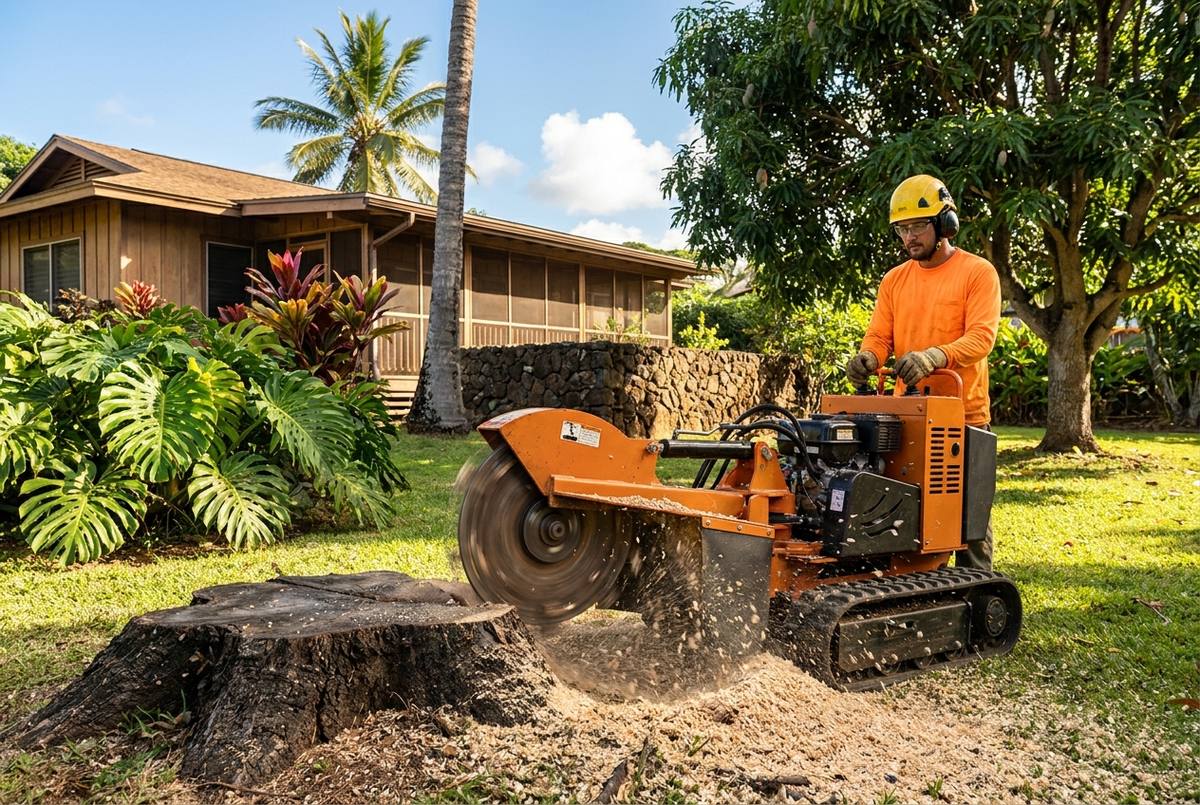
What is the average cost of removing a tree stump in Honolulu?
Most Honolulu homeowners pay between $150 and $500 to remove a single tree stump, with a typical average around $250 to $300. Small stumps in open yards can come in near $110 to $210, while very large monkeypod, banyan, or mango stumps with sprawling root systems can reach $700 to $1,150 or more.
Honolulu prices run higher than what you will find in national cost guides. Statewide, Hawaiʻi home-service pricing sits roughly 35% to 42% above the national average because of prevailing island labor rates, equipment shipping, and green-waste disposal costs. Honolulu itself carries a small metro premium on top of the state average. If a mainland cost calculator tells you $175, plan on closer to $250 in town.
Honolulu stump removal cost by stump size
| Stump size (diameter) | Honolulu price range | Typical examples on Oʻahu |
|---|---|---|
| Small — under 12" | $110 – $210 | Plumeria, papaya, small citrus, hibiscus trunk |
| Medium — 12" to 24" | $205 – $410 | Avocado, small mango, areca palm cluster |
| Large — 24" to 36" | $410 – $680 | Mature mango, coconut palm, ironwood |
| Very large — over 36" | $680 – $1,150+ | Monkeypod, banyan, large albizia |
Other common Honolulu pricing structures
- Per-inch pricing: $4 to $7 per inch of stump diameter, usually with a $150 to $200 minimum for a single-stump call-out.
- Hourly rate: $150 to $250 per hour for the crew and grinder when several stumps or an unusual site is involved.
- Multi-stump discount: 15% to 30% off each additional stump on the same visit, since mobilization is already paid for.
- Bundled with tree removal: adding stump grinding to a tree removal already scheduled typically costs $150 to $500 extra instead of full price, because the crew and equipment are on site.
- Full tree plus stump: a small tree with the stump ground out generally runs $300 to $600 in Honolulu; medium jobs $600 to $1,200; large jobs $1,200 to $2,500 and up.
These are market ranges for planning, not a quote. Stump pricing depends on what a crew finds on site, which is why we give a free written estimate before any work begins. Request your free estimate →
What drives the price of stump removal up or down
Two stumps of identical width can be priced hundreds of dollars apart. Here is what an estimator is actually looking at:
- Diameter and root flare. The visible stump is only part of the job. A wide root flare or surface roots running under a lawn add grinding time.
- Wood hardness and species. Ironwood, kiawe, and monkeypod are dense and chew through grinder teeth. Palms are fibrous and pack the wheel. Both cost more than a soft plumeria stump.
- Access. A stump reachable from a driveway is the cheapest scenario. If the grinder has to fit through a 36-inch gate, cross a lanai, or be carried up a slope in Mānoa or Pālolo, labor climbs.
- Proximity to utilities and structures. Water lines, irrigation, electrical, and property-line walls all require careful hand work and sometimes a utility locate before grinding.
- Soil conditions. Rocky or coral-heavy soil common in parts of Oʻahu dulls teeth quickly and slows the grind.
- Grinding depth. Standard is 6 to 12 inches below grade for lawn or garden. Preparing a spot for a new tree, a foundation, or a driveway needs 18+ inches and full root removal, which costs more.
- Debris handling. Leaving the wood chips on site as mulch is free. Hauling chips and grindings off to a green-waste facility usually adds $50 to $150.
- Urgency. Post-storm and emergency calls typically carry a 20% to 50% premium. Booking ahead of storm season is the single easiest way to save money.
Grinding vs. full extraction vs. chemical removal
| Method | Honolulu cost | Time | Best for |
|---|---|---|---|
| Stump grinding | $100 – $400 per stump | 1 – 3 hours | Almost every residential yard. Fast, clean, minimal disturbance to surrounding landscaping. |
| Full stump & root extraction | $250 – $800+ | Half to full day | New construction, driveways, pools, or replanting a tree in the same spot. Leaves a hole needing backfill. |
| Chemical (potassium nitrate) | $15 – $40 in materials | 4 – 8 weeks, then manual removal | Rarely a good fit in Hawaiʻi. Cheap, but the softening stump attracts termites the entire time. |
| Natural decay | $0 | 3 – 10 years | Not recommended on Oʻahu. A slow-rotting stump is an active pest and fungal reservoir. |
For the overwhelming majority of Honolulu properties, mechanical grinding is the right call. It removes the stump in a single visit, eliminates the tripping hazard immediately, and leaves usable mulch behind. Choose full extraction only when something is going into that exact spot: a new tree, a slab, a fence footing, or hardscaping. Learn more about our stump grinding service and full stump removal service.
Why leftover stumps are a bigger problem in Hawaiʻi
On the mainland, leaving a stump is a cosmetic decision. In Honolulu it is a pest-control decision. Year-round warmth and humidity accelerate every problem a decaying stump can cause:
- Formosan subterranean termites. Oʻahu has one of the heaviest Formosan termite pressures in the United States, and a rotting stump within a few feet of your home is a staging ground for a colony that can move into framing, fences, and lanai posts.
- Carpenter ants and beetles. Decaying wood is prime nesting habitat, and the colonies do not stay in the stump.
- Root-rot fungi. Pathogens like Armillaria and Ganoderma spread through connected root systems and can infect healthy trees and palms elsewhere on the property.
- Aggressive resprouting. Monkeypod, banyan, albizia, and octopus trees push vigorous shoots from a cut stump, so you end up cutting the same tree back several times a year.
- Coconut rhinoceros beetle (CRB). Decaying palm stumps and untreated green-waste piles are documented CRB breeding sites on Oʻahu. Grinding palm stumps and disposing of the material correctly is part of slowing the infestation.
- Liability and resale. An uneven stump in a lawn is a trip hazard for guests and a visible deduction during a home inspection or showing.
The stump removal process, step by step
- On-site assessment. We measure the stump at its widest point, identify the species, look for surface roots, and note access, slope, and nearby utilities.
- Written estimate. You get a fixed price before anything starts, including whether chips stay or go.
- Utility locate and site prep. Irrigation lines, low-voltage lighting, and sprinkler heads are flagged. Walkways, walls, and adjacent plantings get protected.
- Grinding. The cutting wheel works the stump down 6 to 12 inches below grade, taking the root flare and primary root ball with it. Deeper on request.
- Root chasing. Surface roots running toward walkways or driveways are ground out so they do not lift hardscape later.
- Cleanup and backfill. Chips are raked level, left as mulch or hauled away, and the depression is topped with soil so you can sod or replant right away.
- Walkthrough. We confirm depth and finish grade with you before we leave the property.
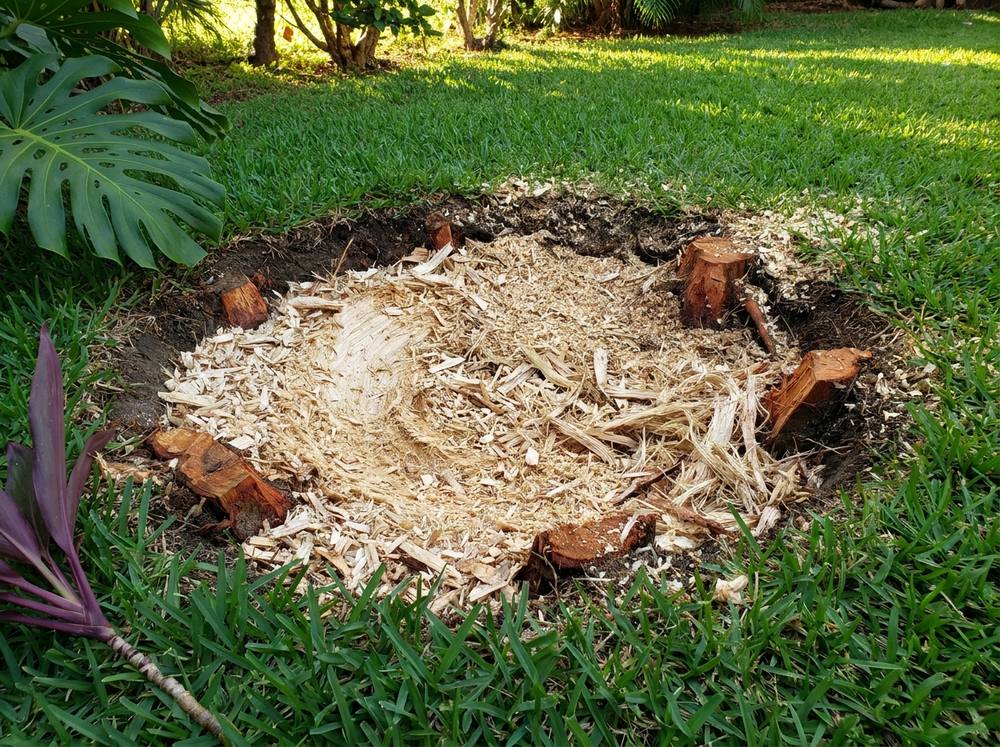
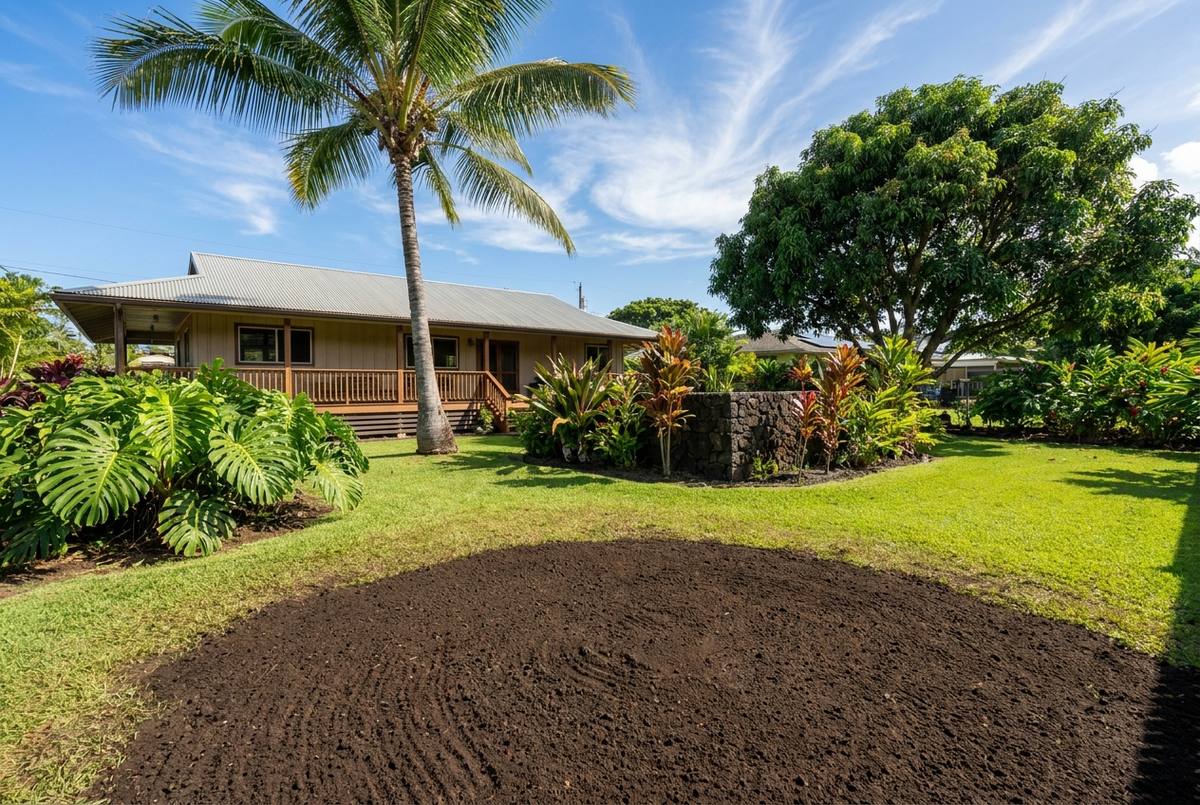
Most single-stump jobs on Oʻahu are done in one visit of one to three hours. Scheduling is typically within a few business days, longer in the weeks after a major storm.
Permits, protected trees, and HOA rules on Oʻahu
Grinding a stump on your own private property generally does not require a permit. There are important exceptions worth checking before anyone starts an engine:
- Exceptional Trees. Hawaiʻi law and the City and County of Honolulu protect designated Exceptional Trees. Work on or near one requires county approval, and penalties for unpermitted removal are significant.
- Street trees and right-of-way. Trees and stumps in the public right-of-way fall under the county's Division of Urban Forestry, not the adjacent homeowner.
- Conservation and shoreline districts. Properties in conservation districts or special management areas face additional state review.
- HOAs, condo associations, and leasehold. Many Oʻahu communities require board notice or approval before removing anything from a common or limited-common area.
- Native and protected species. Some native plantings carry state protections regardless of who owns the land.
When in doubt, confirm with the City and County of Honolulu Department of Planning and Permitting. A licensed local crew should be able to tell you within minutes whether your stump falls into one of these categories.
DIY stump removal vs. hiring a professional
A rental stump grinder runs roughly $200 to $400 per day on Oʻahu, plus a trailer or truck capable of towing it and a fuel and damage deposit. Once you add transport and a full weekend day of labor, the savings against a $250 professional grind are thin, and the risk is not.
DIY can make sense for a single small stump, under about 10 inches, in flat open ground with no utilities nearby. Call a pro when:
- The stump is over roughly 12 inches, or the species is dense hardwood or fibrous palm.
- The stump is within 10 feet of a foundation, wall, pool, septic, or underground utility.
- The property slopes, or the grinder cannot reach the stump without crossing turf, tile, or a lanai.
- You want the area usable for planting or hardscape immediately.
- There is any question about protected-tree status, insurance, or liability for damage.
Stump grinders throw rock and wood at high speed and cause serious injuries every year. Licensed crews carry liability and workers' compensation coverage so that a struck water line or a damaged wall is their problem, not yours.
How to hire the right stump removal crew in Honolulu
- Verify licensing and insurance. Ask for a current Hawaiʻi contractor license number and a certificate of insurance naming general liability and workers' compensation. Get it in writing, not verbally.
- Ask for ISA-certified arborists. Certification signals training in tree biology, rigging, and site safety.
- Get the grinding depth in writing. "Stump removal" means different things to different companies. Six inches versus eighteen inches is a real difference in price and in what you can do with the space afterward.
- Clarify debris and cleanup. Confirm whether chips stay as mulch, get hauled away, and whether the hole is backfilled and raked level.
- Collect two or three written quotes. Wide spreads usually mean the scopes differ, not that one company is generous.
- Be cautious with unusually low bids. An uninsured crew is a liability that follows the property, not a bargain.
- Book off-peak. Scheduling before storm season, and outside the post-storm rush, reliably lowers the price.
Frequently asked questions about stump removal in Honolulu
Most Honolulu homeowners pay $150 to $500 per stump, averaging around $250 to $300. Small stumps under 12 inches run roughly $110 to $210, and very large monkeypod or banyan stumps can reach $700 to $1,150 or more. Hawaiʻi pricing sits about 35% to 42% above national averages because of island labor and equipment costs.
Yes. Grinding chips the stump 6 to 12 inches below grade and typically costs $100 to $400. Full extraction pulls the stump and root ball out of the ground, requires heavier equipment and backfill, and generally runs $250 to $800 or more.
Usually not for a stump on private property. Permits or approvals apply to Exceptional Trees, trees in the public right-of-way, conservation-district properties, and many HOA or condo common areas. Confirm with the Department of Planning and Permitting before work starts.
A typical residential stump takes one to three hours including setup and cleanup. Oversized monkeypod or banyan stumps, or jobs with tight access, can take most of a day.
Yes, if the grind goes deep enough and the wood chips are removed rather than left in the hole. Decomposing chips tie up nitrogen and starve a young tree. For replanting in the exact spot, ask for an 18-inch-plus grind with chip removal and fresh topsoil backfill.
Your choice. Chips make excellent free mulch for garden beds and help suppress weeds. If you would rather have them gone, hauling to a green-waste facility usually adds $50 to $150 to the job.
Not with proper prep. A professional crew locates and flags irrigation lines, low-voltage wiring, and utilities before grinding, and works by hand where lines run close. This is precisely the risk that makes DIY grinding around a developed yard a bad trade.
Rarely. Most policies pay for tree removal only when a covered peril such as a storm drops a tree onto an insured structure, and stump grinding is commonly excluded even then. Review your debris-removal limit before assuming it is covered.